
How to Start a Food Delivery Business in 2026 — Complete Step-by-Step Guide
The global food delivery market is expected to reach $1.41 trillion by 2029, growing at a CAGR of 7.88%. Whether you are an entrepreneur in India, UAE, the USA, or anywhere in between, the food delivery business represents one of the most accessible and scalable opportunities available today. This guide walks you through every step — from validating your idea to launching your app and acquiring your first 100 customers.
Why 2026 Is the Best Year to Start a Food Delivery Business
Consumer behavior permanently shifted after 2020. Today, ordering food online is not a luxury — it is the default for millions of households. Key trends driving growth in 2026 include:
- Super app expansion: Platforms like Swiggy, Gojek, and DoorDash now offer grocery, medicine, and parcel delivery alongside food. Multi-vertical apps attract more users and generate higher order frequency.
- Quick commerce (Q-commerce): The 10-minute delivery model, pioneered by Blinkit and Zepto in India and Gorillas in Europe, is reshaping consumer expectations globally.
- AI-driven personalization: Apps using AI for personalized recommendations, smart routing, and predictive ordering are achieving 30-40% higher retention rates.
- Cloud kitchen boom: Virtual restaurants with no dine-in cost are 60-70% cheaper to operate than traditional restaurants, making them the preferred supplier for delivery platforms.
- Untapped markets: Africa, Southeast Asia, and Latin America have massive populations with low food delivery penetration — massive first-mover opportunity.
Step 1 — Choose Your Food Delivery Business Model
Before writing a single line of code or registering your company, you must decide which business model fits your market, budget, and goals.
Model 1: The Aggregator (Marketplace) Model
You list multiple restaurants on your platform. Customers browse, order, and you either manage delivery or leave it to the restaurants. Examples: Talabat (UAE), Zomato (India), Grubhub (USA). Best for: cities with established restaurant density. Revenue: 15-30% commission per order.
Model 2: The Logistics-as-a-Service Model
You provide the delivery fleet. Restaurants pay you for delivery only — they manage their own online ordering. Examples: Stuart (Europe), DoorDash Drive (USA). Best for: B2B revenue from restaurants. Revenue: per-delivery fee.
Model 3: The Single Restaurant Model
One restaurant brand, one delivery app. McDonald's, Domino's, and KFC all operate branded delivery apps. Best for: established restaurant chains going direct-to-customer. Revenue: direct sales margin.
Model 4: The Cloud Kitchen + Delivery Model
You operate the kitchen and delivery. No dine-in, no rent for visible real estate. Very lean cost structure. Revenue: full margin on every order. Best for: entrepreneurs who want total control.
Model 5: The Niche Delivery Model
Focus on a specific vertical: healthy meals, vegan food, local home-cooked food (tiffin), halal food, or cuisine-specific delivery. Niche platforms face less competition, command better margins, and build loyal communities faster.
Step 2 — Validate Your Market Before Investing
The most common startup mistake is building a platform before validating demand. Here is a proven 2-week validation approach:
- WhatsApp test: Take 20 orders manually via WhatsApp from friends, family, and neighborhood groups. If people pay, demand is real.
- Google Trends check: Search your city + "food delivery app" on Google Trends. Rising trend = opportunity. Flat = saturated.
- Survey 50 potential customers: Ask: How often do you order food online? What do you hate about current apps? What would make you switch?
- Competitor audit: List every delivery app active in your target city. Note their weaknesses: slow delivery, high fees, limited restaurants. Your entry strategy attacks those weaknesses.
Step 3 — Calculate Your Startup Budget
One of the biggest questions from aspiring food delivery entrepreneurs is: how much money do I need to start a food delivery business? Here is an honest breakdown:
| Item | White-Label App (Fast) | Custom App (Full Build) |
|---|---|---|
| App Development | $5,000 – $15,000 | $40,000 – $150,000 |
| Branding & Design | $500 – $2,000 | $3,000 – $10,000 |
| Server & Cloud Hosting | $50 – $200/month | $200 – $1,000/month |
| Payment Gateway Setup | $0 – $500 | $500 – $2,000 |
| Marketing (Launch) | $2,000 – $10,000 | $5,000 – $30,000 |
| Legal & Registration | $500 – $2,000 | $500 – $2,000 |
| Total | $8,000 – $30,000 | $50,000 – $200,000+ |
The white-label route — using a ready-made, customizable food delivery app — is clearly the fastest and most capital-efficient path for most entrepreneurs. You launch in days instead of months, at a fraction of the custom development cost.
Step 4 — Essential Features Your Food Delivery App Needs
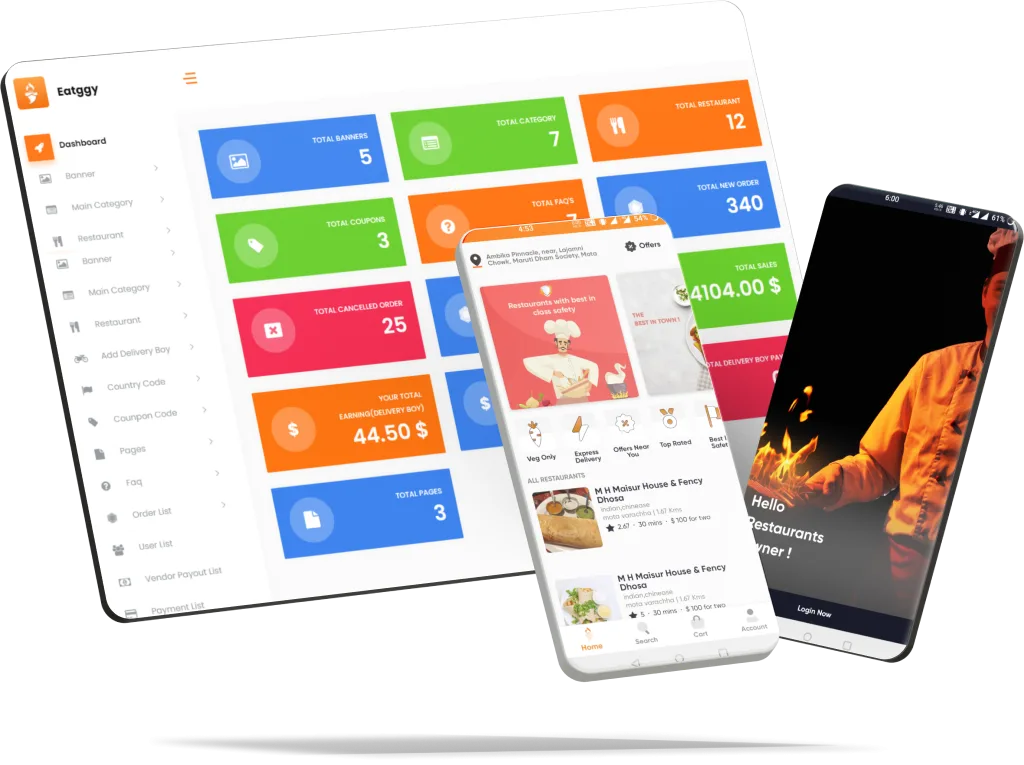
Whether you build custom or use a white-label solution, your platform needs four core apps working together:
Customer App (iOS + Android)
- Restaurant browsing with category/cuisine filters
- Real-time order tracking with live map
- Multiple payment methods (card, wallet, COD, UPI)
- Order history and repeat order feature
- Ratings and reviews for restaurants and delivery partners
- Loyalty points and referral program
- Push notifications for offers and order updates
Restaurant App / Dashboard
- Menu management (add, edit, remove items in real time)
- Order acceptance and rejection controls
- Preparation time setting per order
- Revenue dashboard and settlement reports
- Inventory management integration
Delivery Partner App
- Job acceptance / rejection flow
- Optimized navigation with GPS routing
- Earnings dashboard
- SOS emergency button
- Proof of delivery (photo capture)
Admin Panel (Web)
- Full platform oversight — orders, users, restaurants, drivers
- Commission management
- Promotions and coupon management
- Analytics dashboard (GMV, AOV, retention, top restaurants)
- Payout management for restaurants and drivers
Step 5 — Choose the Right Technology Stack
Your technology choices will determine how quickly you can launch, how smoothly the app performs, and how easily you can scale. In 2026, the recommended stack for food delivery apps is:
- Frontend (Apps): Flutter — single codebase for iOS and Android, 60fps performance, fastest time to market
- Backend: Node.js or Laravel — Node.js for real-time features (order tracking, driver matching), Laravel for robust API architecture
- Database: MySQL for transactional data, Redis for real-time caching
- Maps & Routing: Google Maps API for customer-facing maps, plus routing optimization for delivery dispatch
- Payments: Stripe (global), Razorpay (India), PayTabs or Telr (UAE), PayStack (Africa)
- Cloud: AWS or Google Cloud for auto-scaling during peak hours
- Notifications: Firebase Cloud Messaging (FCM) for push notifications
Step 6 — Launch Strategy and Customer Acquisition
Building the app is only half the challenge. Acquiring your first 1,000 customers is where most delivery startups fail. Here is a proven launch playbook:
Hyperlocal Launch (Best Approach)
Do not try to launch city-wide on Day 1. Pick one neighborhood, 20-30 partner restaurants, and 10-15 delivery partners. Dominate that area before expanding. This reduces burn rate, improves delivery times, and generates real word-of-mouth.
Restaurant Onboarding
Approach restaurants with this offer: "No commission for the first 3 months. We handle delivery. You get more orders." Remove all friction to get your first restaurant partners signed up quickly.
Customer Acquisition Tactics
- Offer codes: Free delivery for first 3 orders for every new user
- Referral program: "$2 credit for you + $2 for your friend"
- WhatsApp groups: Join and promote in local neighborhood WhatsApp/Telegram groups
- Instagram micro-influencers: Pay local food bloggers $50-200 per post
- Corporate tie-ups: Offer office lunch delivery to nearby businesses
- Google Local Ads: Target "food delivery near me" in your specific launch area
Step 7 — Revenue Model and How You Make Money
Food delivery platforms generate revenue through multiple streams simultaneously:
- Restaurant Commission: 15-30% of every order value. Your primary revenue driver.
- Delivery Fee: Charged to customers — typically $0.99 to $3.99 per order depending on distance.
- Subscription Plans: Monthly pass (like DashPass or Swiggy One) for free delivery. Generates predictable recurring revenue and dramatically increases order frequency.
- Surge Pricing: Higher delivery fees during peak hours, bad weather, or high demand periods.
- Advertising: Restaurants pay for featured placement at the top of search results. Premium placement fees of $200-$2,000/month per restaurant.
- Cloud Kitchen Partnership: Revenue share with cloud kitchen brands you host exclusively on your platform.
Real Success Story: How Munch Launched in Australia
Munch, an Australian food delivery platform built using CSCODETECH's white-label solution, launched in under a week, onboarded 50+ restaurants in its first month, and achieved profitability in its hyperlocal launch zone within 90 days. By using a ready-made Flutter app, the founders spent their budget on marketing and restaurant partnerships rather than development — which gave them a massive first-mover advantage in their target suburb.
Common Mistakes to Avoid
- Launching city-wide too early: Thin coverage leads to long delivery times, which kills retention.
- Ignoring delivery partner quality: Your delivery partner IS your brand to the customer. Invest in onboarding and training.
- Underpricing commission: Starting at 5% to attract restaurants is unsustainable. Launch at 15% minimum.
- Building custom when white-label is available: A 6-month development timeline gives your competitor 6 months of head start.
- No post-launch analytics: Track cancellation rate, average delivery time, repeat order rate, and NPS weekly from Day 1.
Conclusion: Start Your Food Delivery Business in 2026
The food delivery market is massive, growing, and still far from saturated in most markets outside the USA and Western Europe. Your competitive advantage does not need to be technology — it needs to be speed, relationships, and hyperlocal execution. Use a white-label app solution to launch fast, validate your market, and then invest in growth.
CSCODETECH offers a complete white-label food delivery app built with Flutter, ready to launch in 2 business days, with full customization, 12+ payment gateways, live tracking, and lifetime updates. Try the live demo today and speak to our team about launching your food delivery business.
Frequently Asked Questions
How much money do I need to start a food delivery business?
Using a white-label food delivery app solution, you can launch for $8,000 to $30,000 including app, branding, server, and initial marketing. Custom app development requires $50,000 to $200,000 and takes 4-8 months longer.
How long does it take to launch a food delivery app?
With a white-label solution like CSCODETECH's, you can launch in 2-3 business days. Custom development typically takes 4-8 months.
What is the best business model for a food delivery startup?
For first-time entrepreneurs, the aggregator model (marketplace connecting restaurants to customers) with a hyperlocal launch strategy has the lowest risk and fastest path to profitability.
Which countries have the best opportunity for new food delivery apps?
Africa, Southeast Asia, Latin America, and the Middle East (UAE, Saudi Arabia) have large populations with rapidly growing smartphone usage but lower food delivery penetration — offering the best first-mover opportunity in 2026.


